01 / OVERVIEW
TODAY
YOUR TODO LIST
IS INFINITE.
YOUR TIME ISN’T.
TODAY / PRODUCT EXPERIMENT 001
DAILY PLANNING / MOBILE / 2026
ROLE
Product designer + researcher
BUILT WITH
Figma · Claude Code · Next.js · Vercel
TYPE
Self-directed product experiment
SCOPE
Strategy · UX/UI · Research · Shipping

ACT I / THE IDEA
Plan with intention, not false precision.
VIEW LIVE PROTOTYPE
↗
PROBLEM
Task tools force flexible intentions into false precision.
PROCESS
Built a working product; tested 5 people, ages 35–70; iterated from observed behavior.
OUTCOME
A daypart planner that separates flexible intentions from fixed commitments.
02 / PROBLEM — FALSE PRECISION
THE GYM DOESN’T NEED
A 2:17 PM TIME SLOT.
I don’t know exactly when I’ll have the energy to go to the gym.
I just know I want to go this afternoon.
INVENTED TIME
GYM → 2:17 PM
FLEXIBLE INTENTION
GYM → AFTERNOON
PRECISE COMMITMENT
DENTIST → 3:30 PM
FALSE PRECISION
INTENTION
REAL COMMITMENT
03 / HYPOTHESIS — DAYPARTS + EXACT TIMES
PLAN WITH INTENTION,
NOT FALSE PRECISION.
If people can plan flexible intentions around parts of their day while preserving exact times for true commitments, planning can feel lighter without sacrificing structure.
MORNING
AFTERNOON
EVENING
NIGHT
SPECIFIC TIME
FLEXIBLE INTENTIONS
FIXED COMMITMENTS
+
Dayparts are deliberately loose: meaningful enough to guide the day, flexible enough to survive it.
WIREFRAME DIRECTIONS
The model stayed constant. The structure changed as I tested how people understood the day.
CARD STACK
Dayparts became separate containers.
TAB-FIRST
Navigation competed with the planning task.
SINGLE DAY CANVAS / CHOSEN
MORNING
AFTERNOON
EVENING
NIGHT
One continuous day made the model visible.
COMPETITIVE MODEL AUDIT
I compared the assumptions behind task lists, timelines, and calendars—not feature counts—to locate a meaningful design opportunity.
FLEXIBLE INTENTION
FIXED TIME
TASK-FIRST
CALENDAR-FIRST
TODOIST
Task hierarchy + dates
TODAY
Dayparts + optional time
STRUCTURED
Daily timeline
SUNSAMA
Timeboxing
GOOGLE CALENDAR
Exact events
OPPORTUNITY
Most products organize work as lists or exact slots. Today explores the middle: meaningful placement without invented precision.
DESIGN DECISION
Dayparts became primary. Exact time stayed available when the commitment required it.
LANDSCAPE AUDIT — DIRECTIONAL, NOT VALIDATION
04 / PROTOTYPE — BUILD TO LEARN
BUILD TO LEARN.
AI compressed the distance between a product hypothesis and observable user behavior. It was the method—not the hero.
01
HYPOTHESIS
→
02
PRODUCT MODEL
→
03
AI-ASSISTED
PROTOTYPE
→
04
WORKING
PRODUCT
→
05
REAL-DEVICE
TESTING
The loop got faster. Product judgment stayed human.
ACT II / BUILD TO LEARN

EARLY BUILD / REAL-DEVICE TEST
05 / RESEARCH — FIRST 5 TESTS
I STOPPED
EXPLAINING.
I watched what people tried before telling them how the product worked.
1
TAPPED MORNING / NO TASKS
BEHAVIOR Tapped an empty Morning header.
INSIGHT It looked actionable.
DECISION Add a clear entry point inside each daypart.
2
LONG-PRESSED TO EDIT
BEHAVIOR Long-pressed a task.
INSIGHT People expected a familiar mobile edit gesture.
DECISION Support the convention.
3
EXPECTED TO SWIPE
BEHAVIOR Swiped between days and dismissed tasks.
INSIGHT Direct manipulation felt more natural than buttons.
DECISION Design gestures with safeguards.
4
TAPPED THE DATE
BEHAVIOR Tapped the date for larger jumps.
INSIGHT The date read as navigation.
DECISION Make it open the calendar.
Five participants, ages 35–70, used the working product without instruction. I watched where instinct overrode the interface.
A personal trainer with an appointment-heavy day preferred Google Calendar. Today’s role became clearer: support flexible intentions; don’t replace a calendar built for fixed commitments.
5 PARTICIPANTS / AGES 35–70 / WORKING PRODUCT / OBSERVED USE
PRODUCT BOUNDARY / WHO TODAY ISN’T FOR
06 / DECISION — HOLD, THEN CHANGE
I HELD RECURRENCE—
UNTIL THE SIGNAL REPEATED.
Four independent signals turned a feature request into evidence.
01
HOLD
One request; interesting, not evidence.
02
LISTEN
The same need appeared independently.
03
REASSESS
The pattern persisted across different jobs.
04
CHANGE
Scope changed; the model held.
The signal changed. So did the decision.
ACT III / EVIDENCE CHANGES THE PRODUCT
01 / HELD
No recurrence. One request wasn’t enough to change the model.
02 / EXPOSED
Recurrence was added visibly to validate the full option set.

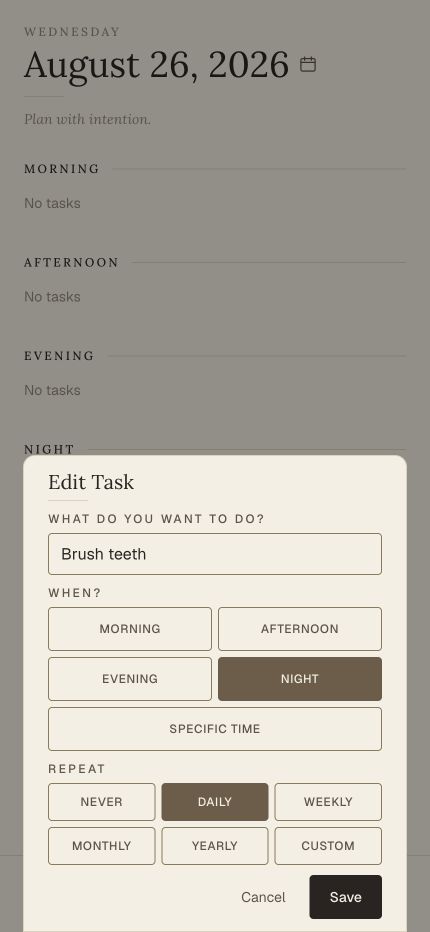
03 / REFINED
Repeat moved behind one row, protecting the fast path without removing control.

07 / SYNTHESIS — FOUR JOBS
ONE REQUEST.
FOUR DIFFERENT JOBS.
Research separated the mechanism people named from the work they were actually trying to support.
1
ROUTINES
2
RESPONSIBILITIES
3
PRECISE
COMMITMENTS
4
IMPORTANT
DATES
The request named a mechanism. The research revealed the work.
Actions repeated on a regular rhythm.
Obligations that return whether or not they feel habitual.
Events that repeat at a specific day or time.
Meaningful context beyond tasks.
08 / SCOPE — RECURRENCE
ANYTHING YOU CAN PLAN
IN TODAY CAN REPEAT.
Recurrence extends the planning model. It doesn’t turn Today into a habit tracker.
FLEXIBLE
WALK DOG
EVENING
DAILY
PRECISE
CURLING
8:00 PM · TUESDAY
WEEKLY
DAILY
WEEKLY
MONTHLY
YEARLY
CUSTOM
NO STREAKS / NO XP / NO HABIT ANALYTICS
Completion can be satisfying without becoming gamification.
INTERACTION HIERARCHY / PROGRESSIVE DISCLOSURE
ALWAYS VISIBLE → SEPARATE ADVANCED STEP → COLLAPSIBLE “REPEAT” / CHOSEN
Recurrence initially competed with the task’s primary decisions: what to do and when. Collapsing it protected the fast path while keeping advanced control available on demand.
DESIGN DECISION — INFORMED BY HIERARCHY; VALIDATE IN THE NEXT TESTING ROUND.
09 / SCOPE — DAY-LEVEL CONTEXT
MOM’S BIRTHDAY
≠
☐ MOM’S BIRTHDAY
Something can matter today without being something the user needs to check off.
TASK
Something I intend to accomplish.
TIMED COMMITMENT
Something I intend to do at a specific time.
IMPORTANT DATE
Something significant about the day.
REMINDER
Something the system should proactively surface.
FUTURE EXPLORATION
Meaningful dates + notifications remain outside the MVP.
10 / FINAL PRODUCT
THE PRODUCT,
AFTER THE LEARNING.
A restrained set of final states: plan flexibly, commit precisely, repeat intentionally, navigate naturally.
PLAN
CLEAN DAYPART OVERVIEW
Flexible + precise together

COMMIT
ADD FLOW
Daypart + optional exact time
REPEAT
REPEAT OPTIONS
Daily, weekly, monthly + yearly
NAVIGATE
DATE PICKER
Jump directly to another day

ACT IV / WHAT I LEARNED
OPEN LIVE PROTOTYPE
↗
11 / IMPACT — WHAT CHANGED
ASSUMPTIONS IN.
EVIDENCE OUT.
The work changed the product—and the way I framed the problem.
BEFORE
AFTER
People need a simpler task list.
→
People need flexible intentions and precise commitments.
Feature requests reveal priorities.
→
Repeated behavior reveals the strength of a signal.
Recurrence is feature creep.
→
Recurrence fits when it extends the planning model.
Important dates belong in tasks.
→
Some day-level context should never become a checkbox.
DELIVERED
Working MVP · research-backed interaction model · defined recurrence scope · testable live prototype
12 / NEXT STEPS
THE MVP IS DONE.
THE LEARNING ISN’T.
Next steps are questions to answer—not a wishlist to ship.
MEASURE
Do dayparts reduce planning friction?
Time to first plan · completion · return rate
RESEARCH
When does recurrence build confidence—or create confusion?
Creation · editing · exceptions · deletion
VALIDATE
Which dates deserve context at the day level?
Birthdays · holidays · annual responsibilities
PROBE
When does a reminder earn the right to interrupt?
Lead time · channel · control · trust
EXPLORE / DELIGHT
Can celebration and optional theme unlocks encourage return use without turning planning into performance?
Completion feedback · optional themes
No streak penalties · validate return behavior
13 / TAKEAWAY
BUILDING FASTER
DIDN’T MEAN
DECIDING FASTER.
AI helped me move from hypothesis to working product quickly. User research determined what deserved to survive.
The most important things I designed weren’t individual screens.
They were the rules
that kept Today simple.
TODAY / PRODUCT EXPERIMENT 001 PRODUCT DESIGN · RESEARCH · SHIPPING 2026
TRY LIVE PROTOTYPE
↗